










Proactive Performance: Building Strength Before Pressure
Most businesses do not fail because of one major event. They deteriorate through a series of small, compounding gaps, missed signals, delayed decisions, and unresolved inefficiencies. Proactive Performance is designed to intercept that process early.
As businesses grow, complexity increases. Decision cycles tighten. Margins compress. What were once minor inefficiencies begin to compound into material risks.
The traditional response is reactive, addressing issues once they become visible in financial results. By that stage, options are already constrained.
Proactive Performance flips this model.
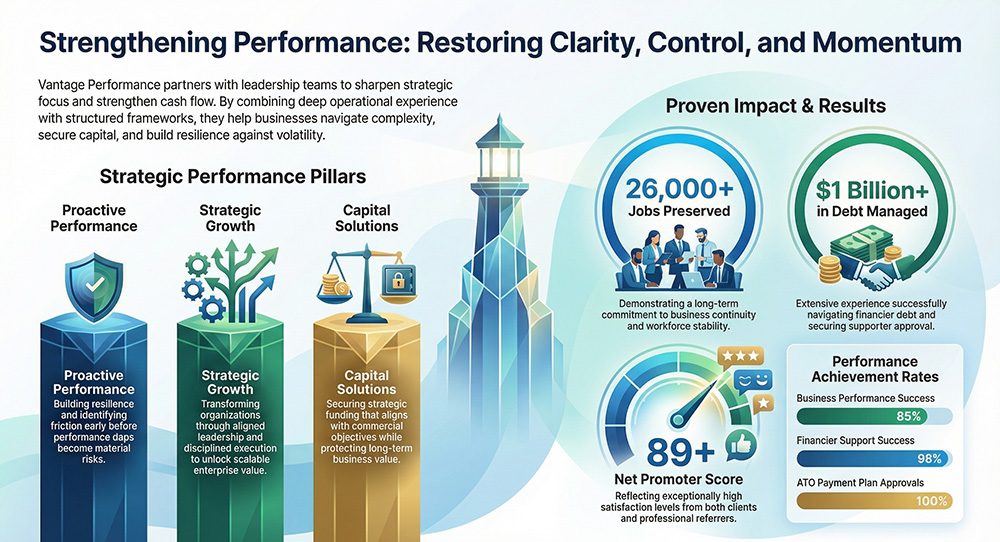
The focus is on identifying performance friction early, removing constraints, and embedding systems that ensure the business performs reliably as it scales.
This is not about over-engineering. It is about strengthening the fundamentals that drive consistent results:
Cash flow visibility and control
Clear accountability across leadership teams
Structured decision-making processes
Execution discipline
Think of it as moving from “managing outcomes” to “engineering outcomes.”
A useful analogy: most businesses operate like driving at speed using the rear-view mirror reacting to what has already happened. Proactive Performance installs a forward-facing dashboard, allowing leaders to anticipate and adjust before issues emerge.
The work typically starts with a business health check:
Where is performance leaking?
Where are decisions being delayed or diluted?
Where is complexity creating unnecessary risk?
From there, the focus shifts to intervention:
Removing operational bottlenecks
Strengthening financial visibility
Clarifying roles and decision rights
Aligning execution rhythms across the business
The objective is not perfection, it is predictability.
Because predictability creates control.
And control creates confidence.
When leaders have clear visibility and structured processes, they can:
Act faster
Allocate resources more effectively
Respond to changing conditions without destabilising the business
The outcomes are tangible:
Stronger, more predictable performance
Greater confidence in leadership decisions
Early identification of risks before they escalate
A business built to handle volatility without disruption
One of the more important, but less obvious, impacts is cognitive load reduction.
In many businesses, leadership teams are overloaded, not because of volume, but because of ambiguity. Unclear priorities, inconsistent data, and reactive firefighting create decision fatigue.
Proactive Performance reduces this burden by:
Establishing clear performance signals
Creating structured decision frameworks
Aligning teams around shared metrics and outcomes
This frees leadership capacity to focus on strategic priorities rather than operational noise.
Another critical element is timing.
Early intervention has asymmetric value. A small adjustment made early can prevent a large correction later. This is particularly true in cash flow management, where minor inefficiencies can compound quickly.
The discipline is simple but often overlooked:
Identify early
Act decisively
Embed sustainably
Over time, this builds organisational resilience. Not resilience as a defensive posture, but as an operational capability. A business that performs reliably under pressure is not reacting better, it is structured better.
That is the essence of Proactive Performance.
Learn more about our Proactive Performance Business Health Checks and how our team can help your business increase confidence and strength