










Why Early Action Changes Outcomes
Timing is the most underestimated variable in business recovery.
Not just whether action is taken, but when. In distressed or high-pressure environments, early action has a disproportionate impact on outcomes.
Effective Governance and Safe Harbour is designed to enable exactly that.
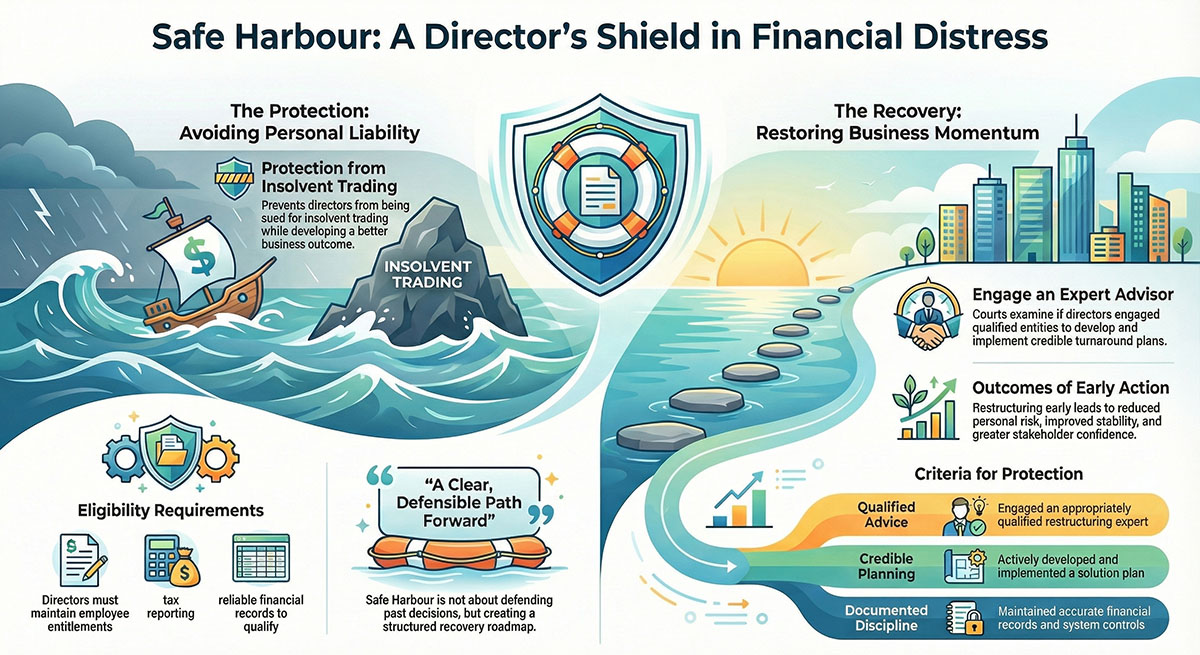
The Critical Decision Window
Directors often hesitate between two risks:
Acting too early
Acting too late
This hesitation is understandable, but costly. Because in most cases, the cost of acting too late far exceeds the cost of acting early.
Why?
Because options diminish over time.
Cash reserves decline
Stakeholder confidence erodes
Financing becomes more constrained
Operational flexibility reduces
By the time pressure becomes visible externally, optionality is already limited.
Early Action Preserves Optionality
Safe Harbour shifts this dynamic. It enables directors to act while options still exist, before the business reaches a point where choices are forced rather than strategic. This creates a fundamentally different trajectory.
Early action allows:
Controlled stabilisation rather than emergency response
Structured stakeholder engagement rather than reactive negotiation
Strategic planning rather than short-term survival
It replaces urgency with discipline.
The Compounding Effect of Delay
Delay does not just maintain the status quo, it compounds deterioration.
A simple analogy:
If a business is losing 2% performance per month, waiting six months does not create a 12% problem. It creates a structurally different business, one with reduced cash, weakened relationships, and fewer recovery options.
This is why Safe Harbour emphasises:
Early identification
Immediate engagement
Structured execution
Because small actions taken early prevent large corrections later.
What Changes When You Act Early
Early Safe Harbour implementation delivers measurable advantages:
Greater confidence in decision-making
Stronger control over cash and capital
Credible stakeholder engagement
Reduced litigation exposure
Improved probability of sustainable recovery
These are not incremental improvements. They are structural advantages.
Shifting from Reactive to Strategic
Without early action, businesses default to reactive behaviour:
Short-term cash fixes
Fragmented decision-making
Defensive stakeholder communication
With early action, the posture shifts:
Decisions are structured
Communication is proactive
Strategy is aligned with execution
This shift is often the difference between recovery and escalation.
The Role of Safe Harbour in Early Action
Safe Harbour exists to remove the primary barrier to early action: fear of liability.
By providing protection when directors act responsibly and develop a credible plan, it enables leadership teams to move decisively without waiting for conditions to deteriorate further.
But this protection is conditional.
It requires:
Discipline
Documentation
Credible execution
Which reinforces the central principle:
Early action must also be structured action.
The Outcome: Better Decisions, Earlier
At its core, early action changes outcomes because it changes decision quality.
Decisions are made with more information
More options are available
Less pressure distorts judgment
This leads to better outcomes, not just faster ones.
A Defining Principle
Across all Safe Harbour engagements, one principle holds:
The right decisions, made early, shape enduring outcomes.
This is not just a statement, it is an operational reality.
Vantage Performance Key Focus Points
Timing directly impacts recovery outcomes
Early action preserves options and control
Delay compounds risk and reduces flexibility
Safe Harbour enables structured early intervention
Decision quality improves when pressure is reduced